Infrastructure Erosion: The Slow Performance Decline That's Quietly Costing You Customers
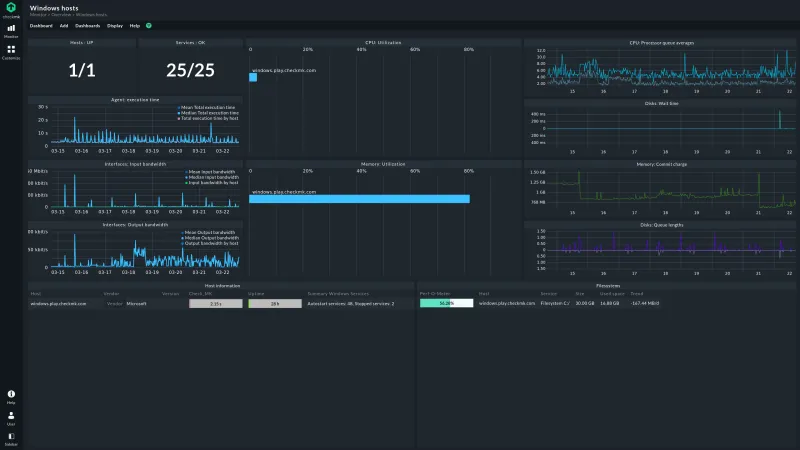
Photo: server room performance monitoring dashboard declining metrics, via checkmk.com
There is a particular kind of infrastructure failure that never makes it into post-mortem reports. It does not trigger emergency calls at 2 a.m., does not generate a flurry of support tickets, and does not produce the kind of dramatic outage that compels leadership to take immediate action. It simply accumulates—quietly, persistently, and at considerable cost.
Gradual server degradation is among the most financially damaging phenomena in web hosting, precisely because it so rarely announces itself. Businesses that would respond decisively to a full site outage often tolerate months of incremental performance decline without recognizing the pattern for what it is. By the time the symptoms become undeniable, the damage—in lost conversions, customer attrition, and search engine penalties—has already compounded into something far more expensive to reverse.
What Gradual Degradation Actually Looks Like
The term "server degradation" often conjures images of hardware failure or catastrophic resource exhaustion. In practice, the early stages look far more mundane. Page load times that once averaged 1.8 seconds begin creeping toward 2.4, then 3.1. Database query response times lengthen by fractions of a second. Time to First Byte (TTFB) metrics drift in the wrong direction across weekly reports. Memory utilization trends upward month over month without any single identifiable cause.
Individually, none of these changes appear alarming. A developer reviewing a single day's metrics might attribute the variance to normal fluctuation. But the pattern, viewed over weeks or months, tells a different story—one of infrastructure under increasing strain.
Common contributing factors include disk fragmentation and I/O bottlenecks on aging storage systems, accumulated software entropy from unpatched operating systems and outdated runtime environments, log file bloat consuming disk space and slowing file system operations, and the gradual degradation of hardware components operating outside their optimal thermal and load parameters.
The Revenue Consequences You Are Not Measuring
The financial case for addressing server performance is well-documented in aggregate, but the specific mechanisms by which degradation translates to lost revenue deserve closer examination.
Conversion rate erosion is perhaps the most direct effect. Research from multiple sources has consistently demonstrated that each additional second of page load time reduces conversion rates measurably—with the most acute impact occurring in the two-to-five-second range where many degrading servers operate. An e-commerce site processing $500,000 in monthly transactions that experiences a sustained conversion rate decline of even 0.5 percentage points is absorbing losses that compound every billing cycle.
Customer churn from poor experience operates on a longer timeline but represents an equally serious threat. Users who encounter a sluggish interface do not always abandon their session immediately. Many complete their transaction—once. The decision not to return is made quietly, without complaint, and rarely attributed by the customer to server performance. It simply registers as reduced repeat purchase rates, declining engagement metrics, and a gradual softening of customer lifetime value figures that finance teams struggle to explain.
Search engine ranking penalties add a third dimension to the cost structure. Google's Core Web Vitals framework has made page experience an explicit ranking signal, meaning that performance degradation is no longer merely a user experience concern—it is an SEO liability. A site whose Largest Contentful Paint (LCP) scores drift from "Good" to "Needs Improvement" over the course of six months may find itself losing organic search position to competitors with better-maintained infrastructure, a consequence that can take a year or more to fully reverse even after the underlying technical issues are resolved.
Why Businesses Miss the Warning Signs
Organizations that would never tolerate a visible outage frequently overlook gradual degradation for several interconnected reasons.
First, there is the absence of a clear threshold event. Human attention is drawn to discontinuities—sudden changes, error alerts, customer complaints. A performance metric that worsens by 3% per month never crosses a single dramatic line. It simply drifts.
Second, many businesses lack the monitoring infrastructure necessary to detect longitudinal trends. Point-in-time performance checks confirm that a server is currently responding; they do not reveal whether response times are trending in the wrong direction over a 90-day window. Without historical baseline data and trend analysis, the early warning signs are effectively invisible.
Third, there is a natural tendency to rationalize isolated data points. A slow afternoon gets attributed to a traffic spike. A sluggish database query is blamed on a recent content update. Each explanation may be locally plausible while the underlying pattern goes unexamined.
Building a Detection Framework That Works
Effective detection of gradual degradation requires a monitoring posture that prioritizes trend identification over threshold alerting. This means establishing clear performance baselines during periods of known-good operation and maintaining continuous comparative visibility against those baselines.
Key metrics to track on a longitudinal basis include server response time (TTFB), CPU and memory utilization trends, disk I/O wait times, database query execution times, and error rate patterns across application logs. None of these metrics should be reviewed in isolation; the value lies in understanding their relationship to one another over time.
Automated alerting should be configured not only for absolute threshold breaches but for rate-of-change anomalies—scenarios where a metric is still within acceptable bounds but deteriorating at an accelerating pace. This forward-looking approach provides the lead time necessary to intervene before degradation reaches the point of measurable revenue impact.
Scheduled maintenance windows for proactive optimization—log rotation, index rebuilding, OS patching, hardware health audits—are equally essential. Infrastructure that receives regular preventive attention degrades far more slowly than infrastructure maintained only in response to incidents.
The Economics of Proactive Maintenance
Businesses sometimes hesitate to invest in proactive monitoring and maintenance, viewing these activities as overhead costs rather than revenue protection measures. This framing inverts the actual financial logic.
Consider the cost structure of reactive infrastructure management: emergency remediation typically commands premium labor rates, revenue losses during degraded operation may span weeks before the problem is even identified, and the compounding damage to SEO rankings and customer retention extends the financial impact well beyond the incident itself. Against this backdrop, the cost of continuous monitoring and scheduled maintenance is not overhead—it is insurance with a demonstrably favorable actuarial profile.
Hosting providers that offer proactive infrastructure management, performance trending, and dedicated technical support represent a qualitatively different value proposition than those that simply guarantee uptime at a point in time. The distinction matters most precisely in the scenarios that generate the least visible alarm: the slow drift, the incremental decline, the silent erosion of performance that no alert ever flags.
Conclusion
Server degradation rarely announces itself. It accumulates in the margins of performance reports, in the slight uptick of bounce rates, in the gradual softening of conversion figures that no single week makes obvious. The businesses most vulnerable to its costs are those with the least visibility into their own infrastructure trends—and the most confidence that because nothing has broken dramatically, nothing is breaking at all.
The infrastructure decisions that protect long-term revenue are rarely dramatic. They are the monitoring frameworks established before problems emerge, the maintenance schedules honored before symptoms appear, and the hosting partnerships built around proactive management rather than reactive response. In infrastructure, as in most things, the most expensive problems are the ones you never saw coming.